ABS or ASA: the same part, one of them fades

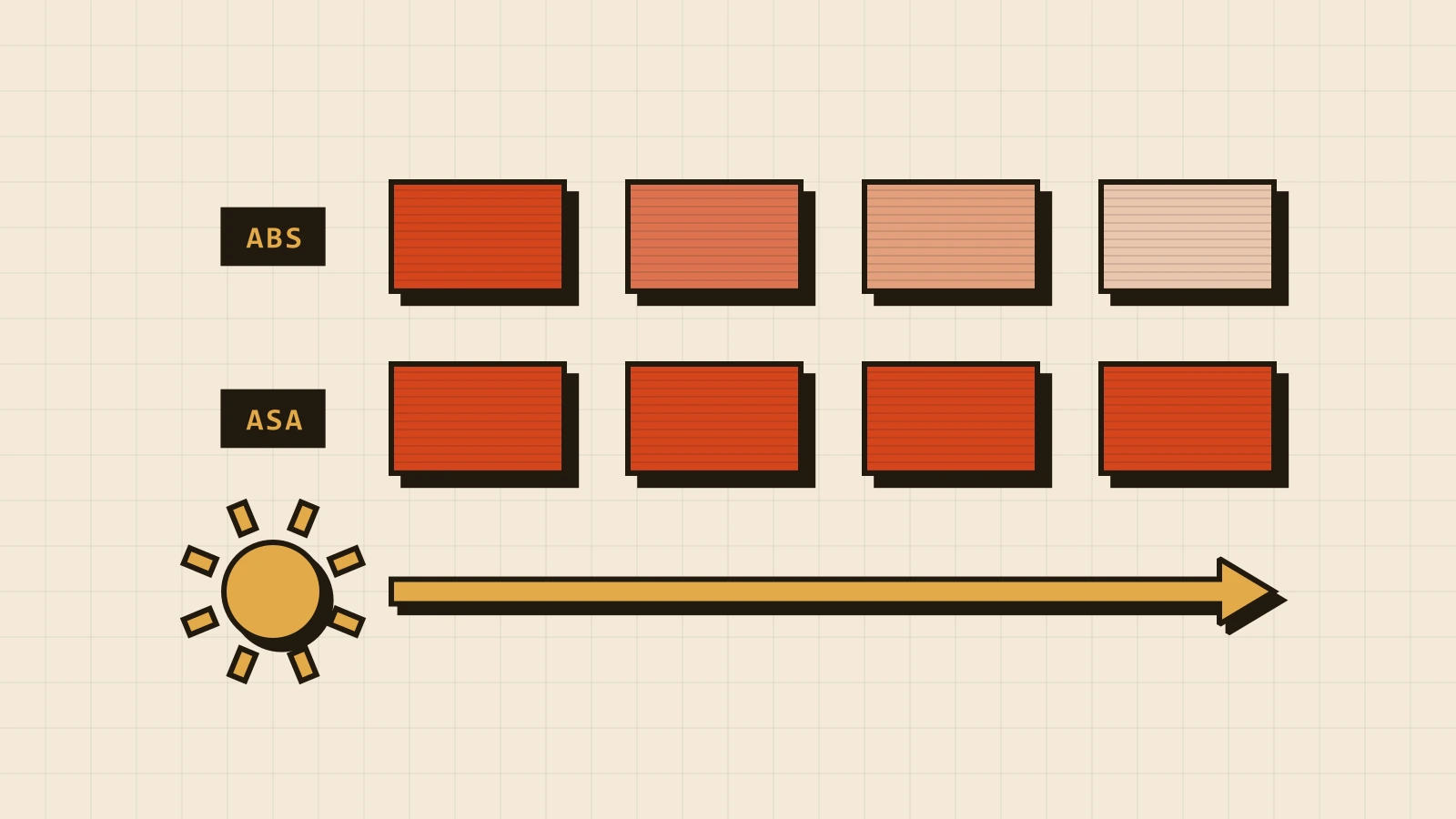
They print the same, they feel the same, and the quote differs by about a tenth. The difference only shows up after a season outside — and then it shows up completely.
The short answer
Indoors — ABS. Outdoors — ASA. There is no third case worth agonising over.
The one thing that is actually different
ABS is acrylonitrile butadiene styrene; ASA is acrylonitrile styrene acrylate. Both get their toughness from a rubber phase mixed through a hard plastic. In ABS that rubber is butadiene, which ultraviolet light breaks down. In ASA it is an acrylic rubber, which it does not.
So the failure is not that an ABS part "looks tired" after a summer. It is that the thing giving the part its impact toughness is the thing the sun removes first: the colour goes, the surface chalks, and the part that used to bend starts to snap.
Side by side
| ABS | ASA | |
|---|---|---|
| Impact toughness | high | the same |
| Service temperature | ~90 °C | ~90 °C |
| Sunlight, months | fades, chalks, embrittles | unchanged |
| Rain and frost | fine | fine |
| Price | the lower of the two | roughly a tenth more |
| Colour range | wider | narrower |
| Printing | enclosed, warm, slow | enclosed, warm, slow |
| Acetone bonding and smoothing | yes | yes |
Read that table twice and you will notice how much of it is identical. Toughness, heat, printing, bonding — all the same. Only two rows move, and only one of them decides anything.
Indoors is not the same as out of the sun
This is the case people get wrong, and it is worth more than a clause.
Ordinary window glass stops most of the short-wavelength ultraviolet and passes a good share of the long. The long end is slower at breaking butadiene down, but it is not idle — which is why upholstery fades on the sunny side of a room and not the shaded one. A black ABS bracket on a south-facing sill is not outdoors, but it is not really indoors either. It ages in years rather than months, quietly, and the first sign is usually that it snaps when you finally unscrew it.
So the question that works is not "is it inside or outside". It is can the part see the sky. A cupboard, a case, an engine bay and a shelf against an interior wall are all genuinely dark. A windowsill, a conservatory, a dashboard and a balcony are all, for this purpose, outdoors.
What a tenth actually buys
The price gap is small and real: roughly a tenth on the quote for the same part in ASA. The mistake is in what it gets compared against.
It is not a tenth versus nothing. For a part that will live in the light, it is a tenth now against the whole thing again later — the reprint, the wait, and the trip back up the ladder to unscrew a bracket that has gone chalky and brittle. Against that, a tenth is not a premium, it is the cheapest line in the quote.
The same arithmetic runs the other way and is worth saying just as plainly: for a part that lives in a dark box, that tenth buys nothing at all. ASA is not a better ABS. It is ABS with one specific weakness removed, at one specific price, and if the part was never going to meet that weakness you are paying for a feature it cannot use.
Three questions
- Will it see daylight for more than a few weeks a year? Yes — ASA. Not "is it outdoors" but "does the sun reach it": a part behind a south-facing window is outdoors as far as UV is concerned.
- Does it live indoors, in a cupboard, a case or a machine? Then ABS, and keep the difference.
- Is an exact colour part of the job? ABS has the wider range. Ask us before you settle on a shade in ASA.
What should not decide it
Strength, heat resistance, how hard it is to print, or how it glues. Those are the same. And the price gap is real but small — small enough that it should never be the reason a part that lives on a balcony gets made in ABS.
Tip from the workshop. Do not ask whether the part is indoors. Ask whether it can see the sky. A windowsill, a dashboard and a conservatory all count as outdoors for ABS.
If you genuinely cannot tell
Send the part and say where it will live — on a desk, in an engine bay, on a fence post. That sentence is the whole decision, and it takes us ten seconds to make it once we have it.
Common questions
Will an ABS part yellow indoors? In a drawer or a case, no — in any useful timeframe it simply sits there. On a sunny windowsill, yes, slowly: glass cuts the harshest ultraviolet but not all of it. If a part lives in a bright room and you will be annoyed when it changes colour, that is an ASA part.
How soon will I notice outdoors? Colour first, and within a season of real sun. The loss of toughness runs alongside it but stays invisible until something gets knocked, which is the part that catches people out — it is a structural problem wearing a cosmetic face.
Is ASA harder to print than ABS? No, and in one way it is slightly easier: it warps marginally less, though it runs a little hotter. Both want the same enclosed, warm, slow machine, and neither is something to run on an open desk.
Can I mix them in one assembly? Yes. They shrink by about the same amount, they tolerate the same temperatures, and acetone bonds either to the other. A common and sensible build is ASA for the parts in the light and ABS for the hidden structure behind them.
What about "UV-resistant ABS"? Stabilised ABS grades and UV-blocking additives exist and do help, but they slow the reaction rather than remove the thing it attacks — the butadiene is still there. For a part you want to forget about for years rather than seasons, the plastic without the weakness beats the plastic with the weakness and a countermeasure.