TPU: how soft is soft enough

People order TPU by feel — "something soft, like rubber". Soft is a number, we stock three of them, and the grade you want is usually not the softest.
The short answer
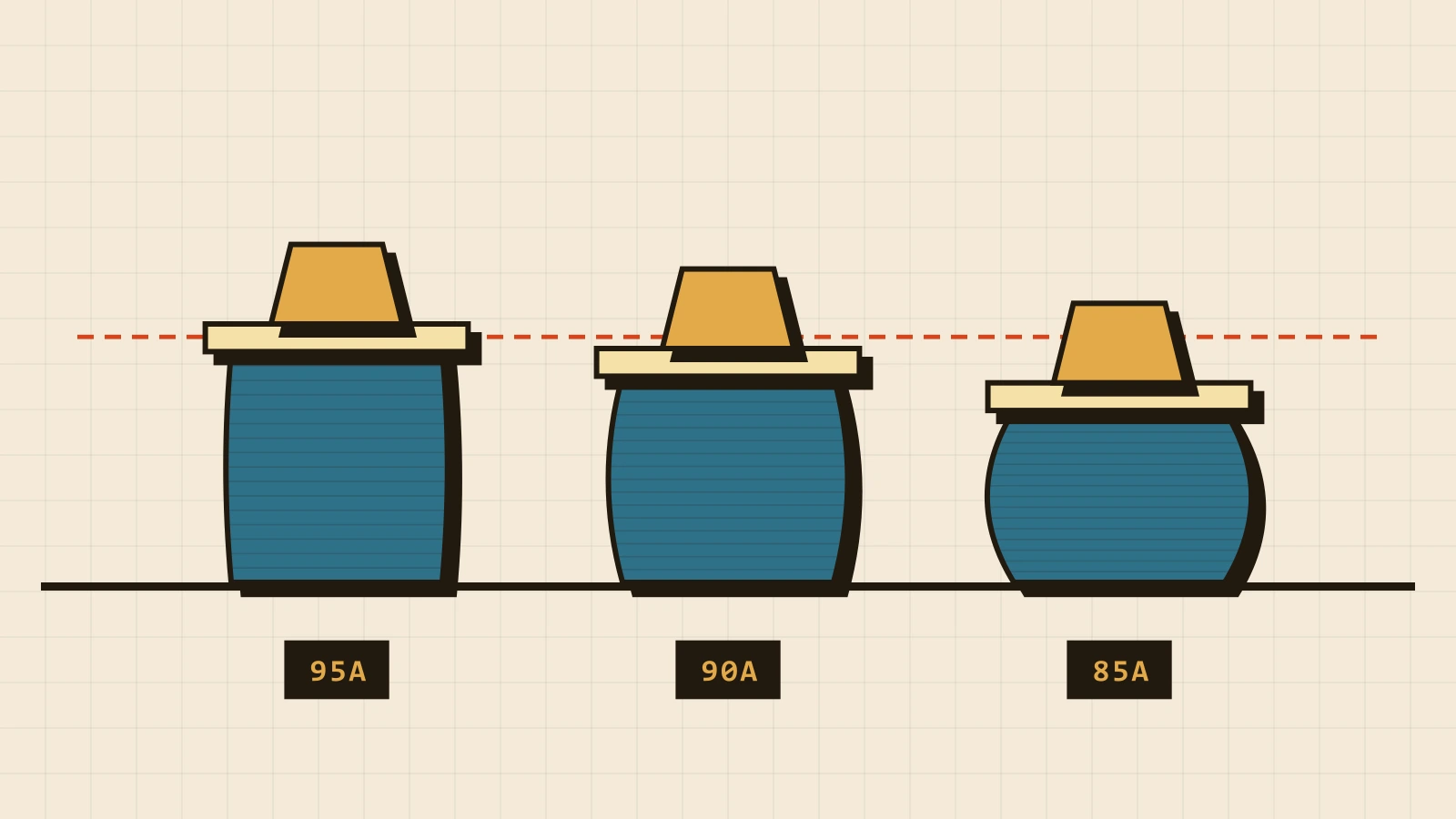
95A when the part has to hold its shape. 85A when it has to stretch over something wider than its own opening. 90A when the honest answer is "in between".
What the number actually means
Shore A is a hardness scale for rubbery things, and lower means softer. A rubber band is around 25A. A car tyre is about 70A. Everything an FDM printer can handle sits well above both: 85A, the softest grade we run, is roughly a work-boot sole, 90A is about a hockey puck, and 95A is a skateboard wheel.
So if you are picturing rubber-band soft, no grade of TPU gets you there. Something else will — read on.
Geometry outranks hardness
This is the part that surprises people. A 2 mm wall printed in 95A with two perimeters and light infill is softer in the hand than the same shape printed solid in 85A. Hardness describes the material; walls, infill and thickness describe the part — and they move the feel much further than one grade step does.
If it feels too stiff, thin the wall before you order a softer grade. If it feels floppy, add a wall rather than a harder one.
There is a practical reason to prefer the geometry lever: changing grade changes the whole part, while changing a wall changes it exactly where you wanted it changed. A phone case can be 95A everywhere and still snap on easily, as long as the rim is thin.
Where each grade lands
| Grade | Feels like | Good for | The catch |
|---|---|---|---|
| 95A | skateboard wheel | gaskets under bolt pressure, feet, bumpers, wheels, drive parts | hard to stretch over anything |
| 90A | hockey puck | cases, grips, straps, handle covers | none in particular — it is the safe default |
| 85A | work-boot sole | seals that must conform to a rough face, sleeves pulled into place, damping pads | detail smears, small text disappears, slowest to print |
Tip from the workshop. Not sure which grade? Order 90A and tell us what the part has to do. It is the safe default, and if the feel needs moving we would rather change a wall than the whole material.
The printer has a vote
There is a second reason the softest grade is rarely the right one, and it is mechanical rather than aesthetic.
Filament is pushed, not pulled. Between the drive gears and the melt zone it is a column under compression, and a soft enough column does not push — it buckles, coils up inside the extruder and jams. How much unsupported length sits in that path is the whole question, which makes it a property of the machine rather than of the plastic.
On a direct drive extruder, where the gears sit directly above the hot end, the practical range runs from about 83A to 98A. Below roughly 83A even a well-tuned direct drive struggles. On a Bowden setup, where the filament travels a metre of tube before it arrives, the window narrows sharply: 95A is already marginal and needs real care, and anything at 87A or below is effectively not printable at all.
This is why "can you print it softer" is a question about hardware, and why the answer for the rubber-band softness people imagine is not a softer TPU but a different process entirely — cast silicone, from a printed mould.
Designing for it
- Avoid support. In a rigid plastic, support snaps off. In TPU it welds itself to the part and takes the surface with it. Rotate the part, chamfer the overhang, or split it in two and glue.
- Clearances forgive in one direction only. A fit that would be slightly too tight in PLA usually works, because TPU compresses. A loose one stays loose — you cannot file a flexible part to size.
- Fine detail comes out soft. Sharp lettering, thin teeth, crisp knurling: expect all of them rounded. This is the material's own trade-off, not a printer setting.
- Fillet the inside corners. TPU almost never splits along its layers. It tears instead, and a tear starts at a sharp internal corner.
- No printed threads. A thread cut in TPU strips the first time it is tightened. Print a plain hole and use a captive nut or a rigid insert.
What it takes at the nozzle
The published windows are narrow, and the softer the grade the narrower they get:
| Setting | TPU 95A | TPU 85A |
|---|---|---|
| Nozzle | 220–235 °C | 230–240 °C |
| Bed | ~50 °C | ~50 °C |
| Speed | 25–40 mm/s | 15–20 mm/s |
| Retraction | near zero | 0.3–1 mm |
| Extruder | direct drive | direct drive, no exceptions |
Retraction is the row that explains the others. Pulling filament back is exactly the motion a soft column cannot survive, so TPU is printed with retraction almost switched off — which means the nozzle oozes between moves, which means stringing, which is why the speed has to come down and the travel moves have to be planned rather than rushed.
And it drinks water. TPU is among the thirstiest plastics on the shelf: a spool left open takes up enough moisture in days to spit and bubble at the nozzle, and the surface comes out matte and rough. Drying runs cooler than for the rigid plastics — roughly 50–60 °C for four to eight hours — because the material itself starts to soften in a hot dryer and a spool can weld to itself.
What it costs
TPU is extruded gently so it does not buckle on the way in, which means it prints slowly — the same part takes noticeably longer than it would in PLA, and the lead time follows. It also sits above the rigid plastics in price, and each step softer adds a few percent more. Both are in the quote before you commit to anything.
When TPU is the wrong answer
A part that must stay stiff and bend in exactly one place is not a TPU part — it is a rigid part with a thin living hinge. Something that has to be soft and survive 80 °C is silicone, and silicone is not an FDM material. And if a part has to be flexible and dimensionally exact, take the hardest grade that still bends enough: every bit of softness you add is accuracy you hand back.
Common questions
Can I print TPU on a Bowden printer? 95A, with care and patience. 90A, rarely and badly. 85A, no — the metre of tube between the gears and the nozzle is exactly the unsupported length a soft filament buckles in. If your machine is Bowden, treat 95A as the floor rather than the starting point.
Does TPU need drying? More than most. It takes up moisture from the air faster than PLA or PETG, and a damp spool shows up as spitting at the nozzle, bubbles in the surface and a part that tears where it should stretch. Dry it cooler than the rigid plastics — around 50–60 °C — because TPU softens in a hot dryer and a warm spool can fuse to itself.
Can TPU parts be glued? Not easily, and not with what is in the drawer. Most plastic cements do nothing to it: they work by dissolving the surface, and TPU shrugs them off. Cyanoacrylate holds but makes a hard, brittle line through a part chosen for flexing, so it fails at the joint. A flexible polyurethane adhesive is the right answer, and designing the split as an overlap rather than a butt joint matters more than the glue does.
How does TPU hold up outdoors? Better than ABS, not as well as ASA. It handles rain and cold without complaint; sustained ultraviolet hardens it over seasons, which for a flexible part means losing the property you bought it for. For something that flexes in the sun year after year, expect to replace it rather than to buy it once.
Can you go softer than 85A? Not on an FDM printer, not reliably. Below about 83A the filament will not push without buckling, whatever the machine. If you genuinely need rubber-band soft, the route is a printed mould and cast silicone — a different process, and one worth asking about rather than forcing this one.