PLA or PETG: choosing the plastic for a part that has to work

Most orders are fine in PLA. The moment a part goes outdoors, into a car or into a loaded joint, that changes — here is the three-question rule we use.
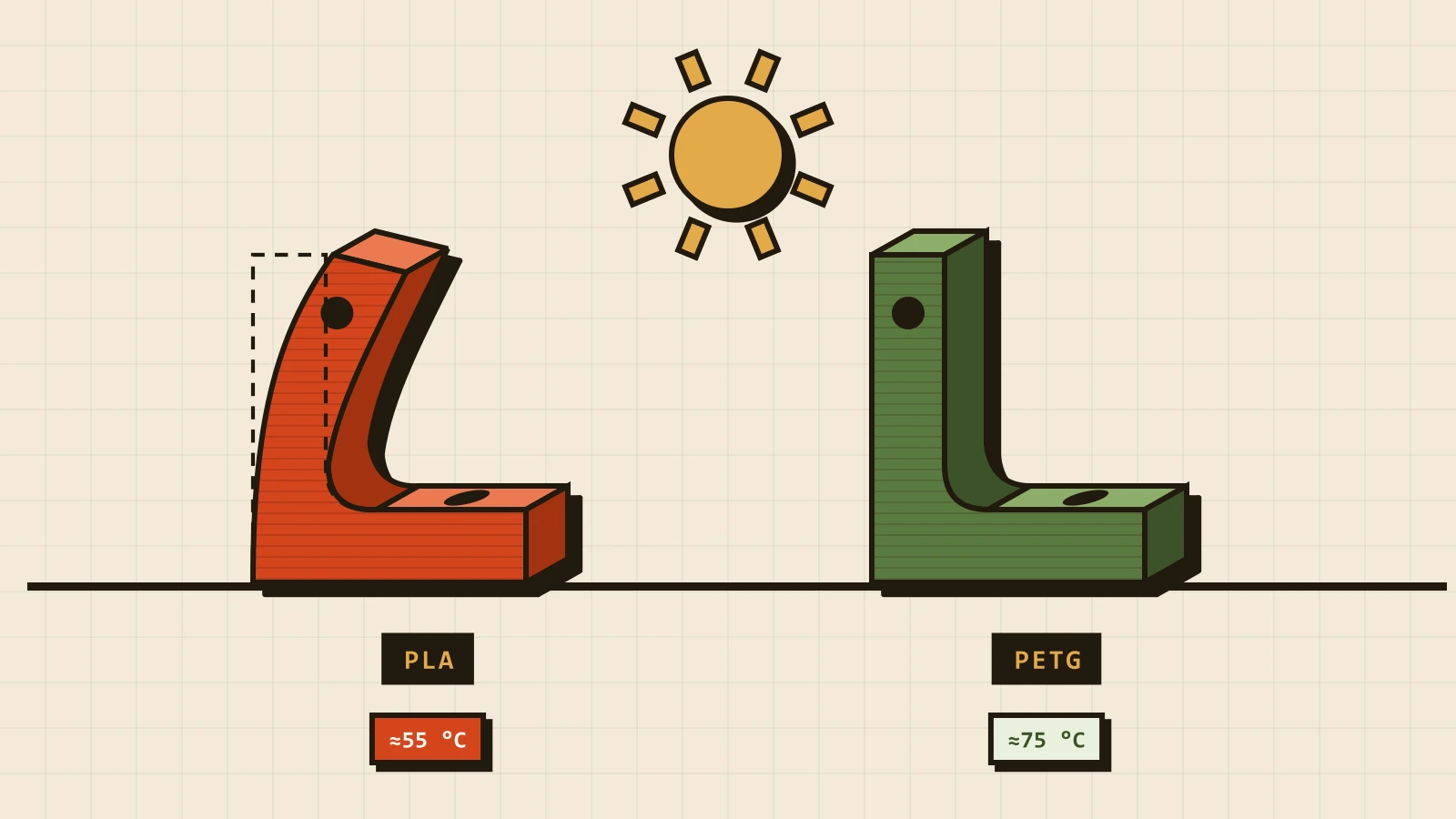
Most orders start with the same question: which plastic? In most cases the answer is PLA. It is cheaper, it prints more reliably, and it holds tolerances better than anything else we run. But the moment a part goes into a car, onto a balcony or into a joint that carries load, PLA stops being the safe default.
The short answer
Indoors and unloaded — PLA. In a car, outdoors, or inside a mechanism — PETG.
If that covers your part, you can stop reading. The rest is why.
Where PLA gives up
PLA softens at a lower temperature than most people expect. Its glass transition sits around 60 °C, and a dark part behind a car windscreen in July gets there easily — the part does not melt, it slowly relaxes and loses its shape. Sunlight does the rest: PLA yellows and grows brittle after a season outdoors.
PETG holds its shape roughly 20 degrees higher, takes an impact instead of cracking, and shrugs off UV for years rather than months.
How hot a car actually gets
That first claim is worth pinning to a number, because "a hot car" sounds like an exaggeration until somebody measures it. Researchers at UC San Diego and Arizona State University parked cars on days that reached 35 °C or more and logged what happened inside. After one hour in the sun the cabin air averaged 47 °C — and the dashboard averaged 69 °C. Parked in the shade, the cabin settled at 38 °C and the dashboard still reached 48 °C.
Set that against PLA's 60 °C glass transition. A phone cradle on a dashboard in the sun is not approaching the limit, it is past it; in the shade it is merely close. Nothing dramatic happens — no dripping, no smell. The clip simply relaxes a little on each hot afternoon, and one day it no longer grips.
Which is also why "it survived last summer" is weak evidence. The failure is cumulative: every spell above the glass transition lets the part creep a little further out of shape, and it never creeps back.
What that means in practice
| Property | PLA | PETG |
|---|---|---|
| Service temperature | up to ~55 °C | up to ~75 °C |
| Impact resistance | low — cracks | high — bends first |
| Sun and weather | yellows, goes brittle | holds up |
| Dimensional accuracy | best of the two | slightly softer edges |
| Ease of printing | easiest | needs a little tuning |
The last two rows are the reason we do not simply print everything in PETG. PETG is slightly stringier and a little less crisp on fine detail, so for a display piece or a part with a tight press fit, PLA is genuinely the better choice — not just the cheaper one.
Stronger is not the same as tough
"Which one is stronger" is the question we are actually asked, and it has an awkward answer: on a straight pull test, PLA usually wins. Published figures put PLA's tensile strength around 50–60 MPa against PETG's 45–55, and PLA is the stiffer of the two.
PETG wins nearly everywhere else that decides whether a working part survives. Impact resistance runs roughly 8–9 kJ/m² against PLA's 5, and elongation at break 7–13 % against 2–7 %.
Read that as two different ways of failing. PLA carries a steady load slightly better and then lets go all at once, the moment something knocks it. PETG deforms first — and a part that is visibly bending is a part telling you it is overloaded while you can still do something about it.
One honest caveat before you quote those numbers at anyone: the spread between brands is wider than the spread between these two names. A premium PETG and the cheapest spool on the shelf are not one material, and neither are two PLAs. Treat the figures as the shape of the difference, not as a datasheet for the reel in your hand.
Choosing in 30 seconds
Ask three questions about the part:
- Will it sit in direct sun, or in a closed car?
- Will anything pull, twist or drop it?
- Does it have to fit another part with less than 0.3 mm of clearance?
A yes to either of the first two — take PETG. A yes only to the third — take PLA and tell us about the fit so we can compensate for it. No yes at all — PLA.
Tip from the workshop. If you are not sure, tell us in the order where the part will live. We will pick the material, and say so if PLA will not hold up.
What PETG asks of the printer
If you are printing this yourself rather than ordering it, the difference between the two materials is mostly patience. The published starting windows are consistent across manufacturers:
| Setting | PLA | PETG |
|---|---|---|
| Nozzle | 190–220 °C | 230–250 °C |
| Bed | 50–60 °C | 70–90 °C |
| Speed | fast | 40–60 mm/s |
| Part cooling | full | off for the first layers, then 30–50 % |
| Retraction | forgiving | 1–2 mm direct drive, 3–7 mm Bowden |
The cooling row is the one people get wrong. Running the fan flat out on PETG buys a slightly tidier overhang and costs layer adhesion — which is most of the reason you chose PETG in the first place.
Then there is the setting that is not a setting: PETG is hygroscopic. It pulls water vapour out of the air, and that water flashes to steam at the nozzle — stringing, a rough matte surface, layers that peel. More PETG prints are spoiled by a damp spool than by bad numbers in the slicer. Manufacturer drying guidance converges on 65 °C for six to eight hours.
If you are ordering rather than printing, none of this is your problem. It is, however, part of why the same file quotes a little higher in PETG than in PLA.
When neither is right
If the part lives above 80 °C, needs to flex repeatedly without fatiguing, or has to survive solvents, this comparison is the wrong one — that is ABS, nylon or TPU territory. Send the file and say what it has to survive; we will tell you if the answer is one of those instead.
Common questions
Will PLA melt in a car? It will not melt, but that is the wrong thing to worry about. PLA starts softening around 60 °C, and measured dashboard temperatures average 69 °C after an hour in the sun. A PLA part in a parked car loses its shape gradually rather than dramatically — which is why people so often blame the design instead of the material.
Is PETG stronger than PLA? Not in tensile strength; PLA is usually higher there. PETG is tougher, which is a different property: it absorbs impact and bends instead of shattering, and it keeps working at temperatures where PLA has already given up.
Can I print PETG on a printer that has only ever run PLA? Almost certainly. PETG wants a hotter nozzle and bed, both within reach of any current machine, and it needs no enclosure. What it does need is a dry spool and a slower first attempt.
Does PETG warp like ABS? Much less. PETG shrinks little and rarely lifts off the plate. Its problem is the opposite one — it can stick to a smooth plate hard enough to take a chip out of it, so a thin release layer is worth the trouble.
Is PETG food safe? The raw polymer is widely used in food packaging, but a printed part is a separate question. Layer lines hold bacteria that washing does not reach, and the nozzle, the plate and any colourant sit outside that approval. For anything reusable that touches food, a printed part is not the right answer.