Not the plastic: what actually makes a print expensive

The plastic is the part of the price everyone thinks about, and nowhere near the biggest. Almost all of what you pay is time — only a little of it the printer’s. Where the money in a quote actually goes, on published prices rather than ours.
Start with the plastic, because it is the easy one
Price trackers put standard PLA at around two cents a gram this year, PETG a shade under, with the wider market at roughly $15–30 a kilo. Engineering grades leave that behind fast: nylon, PC and the carbon-filled compounds run $70–150 a kilo.
So a 40 g bracket is about 80 cents of PLA. Hold that figure — the other two lines are the surprise.
Filament is the line you can see. The line that decides the price is a person's time.
The machine costs less than people think
A modern enclosed desktop machine averages roughly 0.1 kWh an hour over a print — something like 850 W for the first minute while the bed heats, then a few tens of watts. At European domestic rates a three-hour print is small change. Depreciation is the bigger half and still small: a printer in the €500–900 class, spread over a few thousand printing hours, is cents an hour, plus nozzles, belts and build plates.
So why does every quote scale with print time? Because a printer does one job at a time. Six hours on the plate is six hours the next order waits, and a shop with three machines sells hours, not kilograms. Print time is priced as capacity, not as electricity — which is why it is quoted by the hour, a couple of dollars an hour for desktop FDM and orders of magnitude more for industrial equipment.
The expensive thing is a person
Slicing, starting, coming back, lifting the part off the plate, cutting supports away, checking it, packing it, posting it. Pricing guides for print services budget something like fifteen to thirty minutes of human attention per job for that — the same fifteen to thirty whether the part weighs 3 g or 300 g.
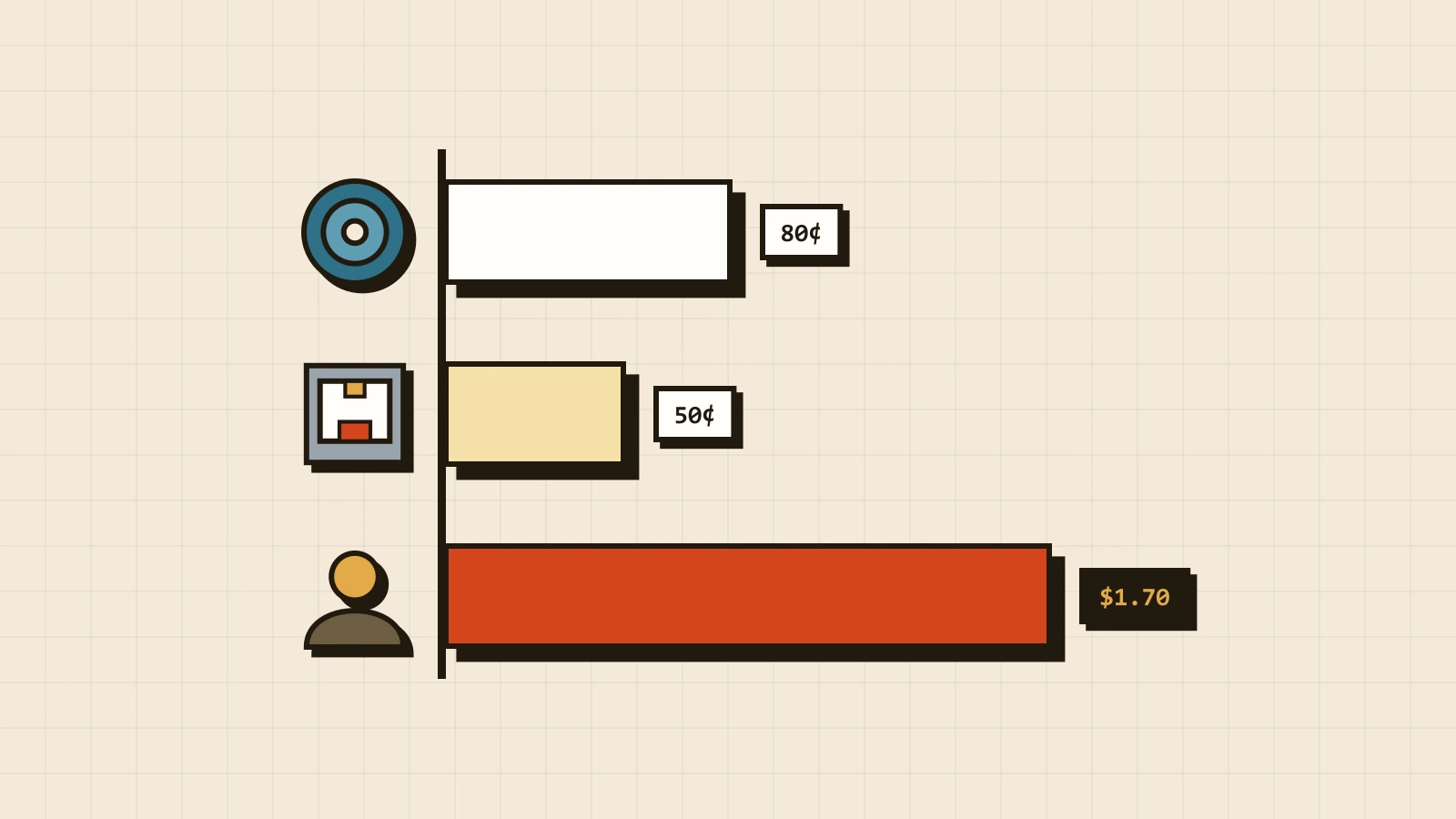
Put the three lines together for that 40 g bracket on a two-hour print. The wage is the one number nobody else can supply, so take a deliberately modest one — five dollars an hour, a workshop rate rather than a Western one:
- filament: about 80 cents
- machine: about 50 cents, depreciation and electricity together
- twenty minutes of a person: about $1.70
The person is the largest line even at the wage least likely to make that true. At €15 an hour, which is roughly what those twenty minutes cost across most of Europe, it is €5 and there is no argument left. Put in the wage you believe in — the ordering does not change, only the gap.
That is why services everywhere either have a minimum order or quietly bury one in the first unit's price. Ours is ten dollars, euros or pounds — a fixed minimum in each currency — and it is not a fee for the plastic.
Industrial additive manufacturing measures the same effect at a scale where it gets measured properly: the Wohlers report has put pre- and post-processing at around 40 % of what a part costs, and in metal the quoted range is 30–70 %. Those are not desktop numbers and do not transfer — different machines, different post-processing entirely. They are here because they point the same way: the printing is the cheap part of printing.
And some of it gets thrown away
Two more things you are paying for that never reach you. Supports are bought filament, printed to be snapped off and binned. And prints fail: surveys of desktop FDM put failure rates anywhere from a few per cent in a controlled workshop to 20–40 % in an open studio with casual users. Whatever a shop's real number is, the reprints are in the price of the prints that work.
What a failure costs is not the plastic. It is everything spent up to the moment it let go: a part that comes off the bed at hour eleven of a fourteen-hour print has burned eleven hours of machine and a spool's worth of attention, and the clock starts again at zero.
So the risk is not spread evenly, and pricing it is not a swindle. A tall part on a small footprint, a broad flat panel in a plastic that shrinks as it cools, a first layer with almost nothing touching the bed — each is a different proposition from a palm-sized bracket, and every shop carries that somewhere. Most, ours included, carry it as a flat allowance folded into every job rather than a surcharge on the scary ones. For genuinely awkward geometry it stops being an allowance and becomes a quote written by hand.
What you can actually change
- Ask for walls, not infill. CNC Kitchen's tests are clearest on this: at equal weight, added perimeters beat added infill by about 22 % in strength. Two extra walls cost a little plastic and a little time; 50 % infill costs a great deal of both.
- Order more than one. Bed heat, purge and calibration happen once per plate however many copies stand on it, and the handling is per job, not per part. Ten of a bracket is not ten times one, anywhere.
- Rotate it before you ask for supports. Support costs filament, minutes to remove, and leaves a scar where it touched. A 45° chamfer instead of a flat ledge often removes the need entirely, and it is free.
- Do not confuse light with cheap. Perimeters print slowly and infill prints fast, so a lattice can take longer on the plate than the solid block it was carved out of while weighing a third as much.
- Pick the material for the job, not the quote. PLA and PETG sit within pennies of each other. TPU, nylon, PC and the carbon-filled grades genuinely cost several times more, and there the material becomes a line worth arguing about.
Tip from the workshop. Slice the file in Bambu Studio before you send it. A 3MF carries the slicer’s own time and weight, so the estimate stands on the numbers the printer will actually run rather than on ours — a minute of your time for a figure closer to the final one.
Why our quote is a range
Because an estimate should say how much it knows. For an ordinary part we can measure, the range is 10 % wide from its low end to its high end — 5 % either side of the middle. Thin-walled and intricate geometry gets 20 %, because that is where an estimate from volume and surface area is weakest, and it should say so rather than pretend. A 3MF you sliced yourself does not narrow the range, but it puts the middle of it on the slicer's own time and weight, and nothing we infer beats those.
What does not move it
The colour, as long as we stock it. How long you spent modelling the part. How intricate it looks: a cube and a week of CAD, at the same size, in the same plastic and equally printable, come to the same money — the machine has no opinion about clever geometry.
That last word is doing the work, though. Complicated to look at is free; complicated to print is not. Height on a narrow base, large flat areas in ABS or ASA, unsupported spans, overhangs that have to be propped — those turn into supports, into minutes of someone's attention and sometimes into a second attempt, and all three are real cost. The automatic estimate sees none of that, so for a part like this the quote a person writes may differ from it.
And if a quote looks wrong for what you uploaded, it sometimes is. Say so in the notes and we re-quote it by hand.
Common questions
Why does a one-gram part still cost about ten? There is a floor under every quote — ten dollars, euro or pounds depending on where you are — and it is not a margin grab. A tiny part still needs the plate heated, the first layer watched, the piece taken off, checked, bagged and labelled. None of those minutes shrink with the object. Below the floor we would be paying for the privilege of taking the order.
Does turning the infill down make it much cheaper? Less than people expect. Infill prints fast and weighs little; the perimeters and the solid top and bottom are where both the plastic and the minutes actually go. Going from 20 % to 10 % on an ordinary part usually moves the number by a few percent, not by a third — and it costs real strength for that little.
Why do I pay for support I throw away? Because it was printed. Support is filament pushed through the nozzle and time spent laying it down, followed by more time removing it and tidying the mark it leaves. It is the most expensive plastic in the job precisely because none of it goes home with you — which is why rotating the part is the best-value minute anyone spends on it.
Is one large part cheaper than several small ones? Against several separate orders, yes, clearly. On a single plate the gap narrows a lot: the heating and the calibration happen once either way, and what is left is the printing. Splitting a part because it does not fit the plate is not a penalty. Sending it as three orders on three days is.
Why did the price change after a person looked at it? The automatic pass reads volume, bounding box and surface area, and tells you how confident it is. A person reads what the part has to do. An overhang that needs propping, a wall too thin to survive the post, a wide flat face that will warp in ABS — those move the number in either direction, and the hand-written figure is the one that counts.